

By mid-October, driving around Harrogate becomes noticeably harder.
Fallen leaves gather along the Stray and on the lanes towards Knaresborough, and morning fog often settles in the valleys. Once the clocks go back on 25 October, many evening journeys on the A61 and A59 will take place in the dark. With motoring costs still high, it helps that brake pads are easy to check and needn’t be expensive to replace.
When the road turns slick and the discs turn orange
The Highway Code states that stopping distances on wet roads can be at least double those on dry roads, and wet leaves reduce grip further. Brakes cannot make up for a slippery surface, but they should respond in the same way every time. Worn pads make this harder to rely on.
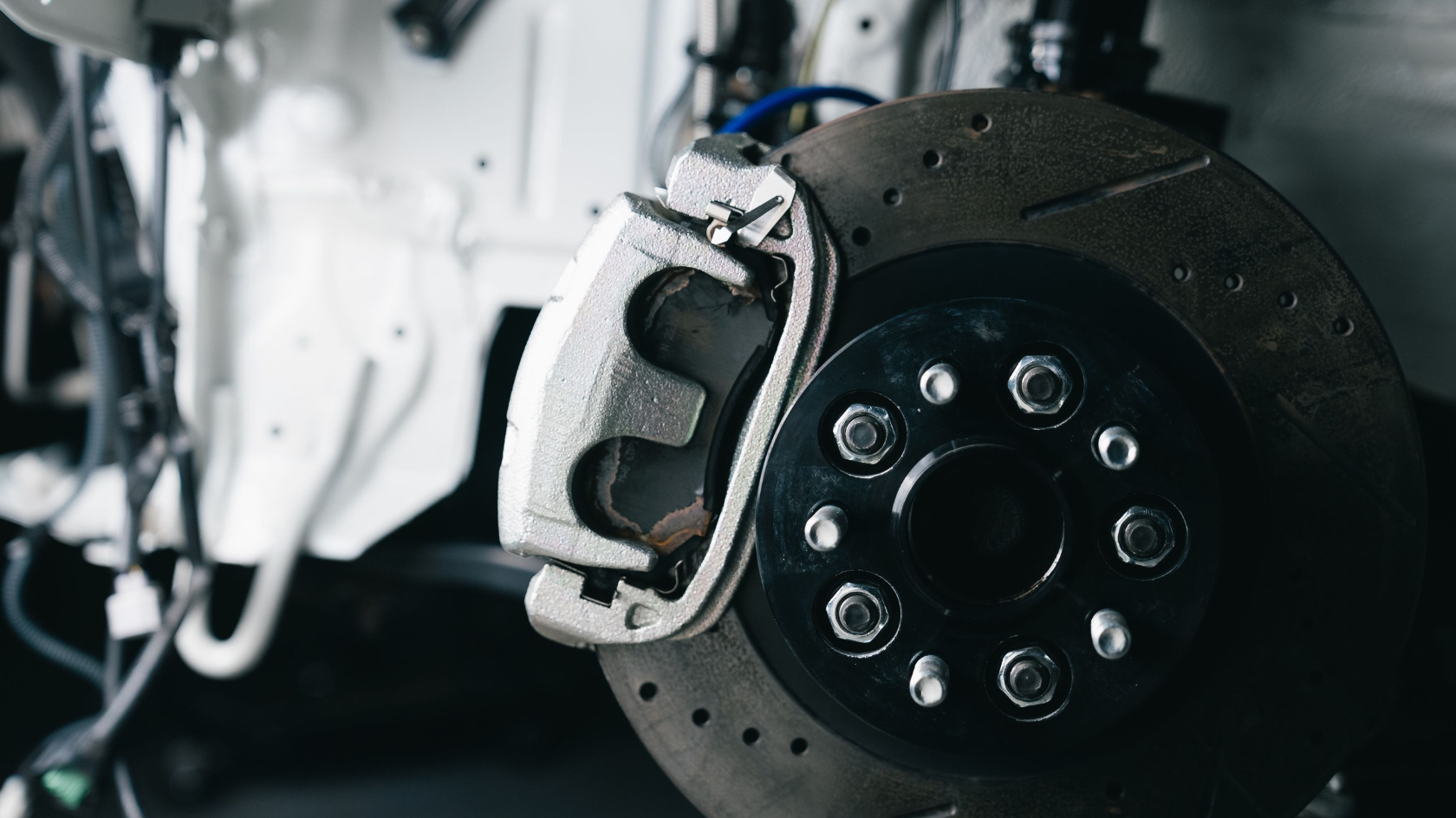
Damp weather also affects the discs. A car left in the rain for a day or two often shows a thin layer of orange rust, which usually disappears after a few gentle stops. If the rust does not clear, the disc surface looks pitted, or a rarely used car starts to judder when braking, both the discs and the pads should be checked.
What worn pads are trying to say
Pads rarely fail without warning, although no single sign is enough to confirm a fault.
- Squealing. Many pads have a metal wear indicator that squeals when the material gets thin. Dust or moisture can cause a similar noise, so a squeal calls for a check rather than automatic replacement.
- Grinding. This may mean the pad material has worn away and metal is touching the disc. A small stone caught in the brake can sound similar.
- A warning light. Cars with wear sensors show a light when the pads reach their limit. The same light can also mean the brake fluid is low.
- A softer pedal or pulling to one side. Possible causes include worn pads, air in the system, old fluid or a sticking caliper, so a proper diagnosis is needed.
New pads usually have around 10 to 12 mm of material, and many manufacturers recommend replacement at about 3 mm. The exact figure for each car is given in the handbook.
Mileage, wear and the price of a fresh pair
There is no single mileage that suits every car. Front pads usually wear faster because they do most of the braking. How long pads last depends on driving style, vehicle weight and the amount of stop-start town driving. Daily trips through Harrogate town centre wear pads differently from regular runs out to Ripon.
Quotes in and around Harrogate will vary, but the cost of front and rear brake pads stays within a fairly predictable range. Knowing this range in advance makes it easier to judge whether a garage quote is fair or whether doing the work at home makes sense.
Pads are always replaced in pairs on the same axle. If the discs are worn below their minimum thickness, they must be replaced too, as new pads on worn discs will not perform as they should.
Paying for quality rather than the badge
Pads do not have to come from a main dealer. Well-known names include Brembo, ATE, TRW, Textar and Ferodo, many of which also supply carmakers with parts for new vehicles. Other brands focus on lower prices, are sold mainly online and cover the same models for less. Both can suit everyday driving, as long as the pads carry ECE R90 approval. This is required in the UK and EU and confirms that performance is comparable to the original part.
When comparing prices online, many drivers will come across RIDEX, a brand founded in Berlin in 2016 whose range includes brake parts, filters, suspension parts and other everyday replacements. The company has published an overview of RIDEX and its parts, which explains how it keeps prices lower and how its range is organised. It also states clearly that its parts are designed for routine replacement and everyday driving. As with any brand, owner reviews are a useful addition.
The number that matters more than the model name
Even cars of the same model can use different brake parts, depending on engine size, model year, trim level or whether a wear sensor is fitted. Choosing by make and model alone is a common reason for ordering the wrong item. A more reliable method is to use the OE (original equipment) number. It is often stamped on the back of the old pad, and a dealer can also find it from the registration number or VIN.
Where a good part can still go wrong
Even the right part can wear out early if it is fitted incorrectly. Drivers who change their own pads should clean and lightly grease the caliper slide pins, keeping grease off the braking surface, and check that the caliper pistons move freely. Bolts should be tightened to the manufacturer’s torque, and new pads should be bedded in with several moderate stops before any hard braking. A local independent garage can also fit parts that drivers have bought themselves, which still saves on cost.
One week before the clocks go back
The days before 25 October are a good time to check the brakes. Listening for unusual noises, watching for warning lights and looking at the pads through the wheels will help spot most problems early, while the evenings are still fairly light.