


Most shock absorbers last around 4 to 5 years, or somewhere between 50,000 and 100,000 miles.
That's the honest answer but it's a range, not a fixed number, because the exact lifespan of a shock absorber depends almost entirely on how and where the car is driven, not on the calendar.
Two identical cars can reach very different mileages before their shocks wear out. A car doing steady motorway miles will usually get far more life out of its shocks than one doing daily school runs over speed bumps and potholed side streets which is why the range of car shock absorbers on AUTODOC covers options built for very different driving conditions. So instead of watching a mileage counter, it's more useful to understand exactly which factors push that number up or down and that's what the rest of this guide focuses on.
What actually determines shock absorber lifespan
Shock absorbers work by controlling the movement of the springs every time a wheel hits a bump. Each compression and rebound cycle uses hydraulic fluid pressure inside the unit. Over tens of thousands of these cycles, the internal seals, valves, and fluid gradually lose their ability to do this smoothly. How quickly that happens comes down to five main factors.
To see how these five factors compare at a glance, here's a quick visual breakdown before we go through each one in more detail:
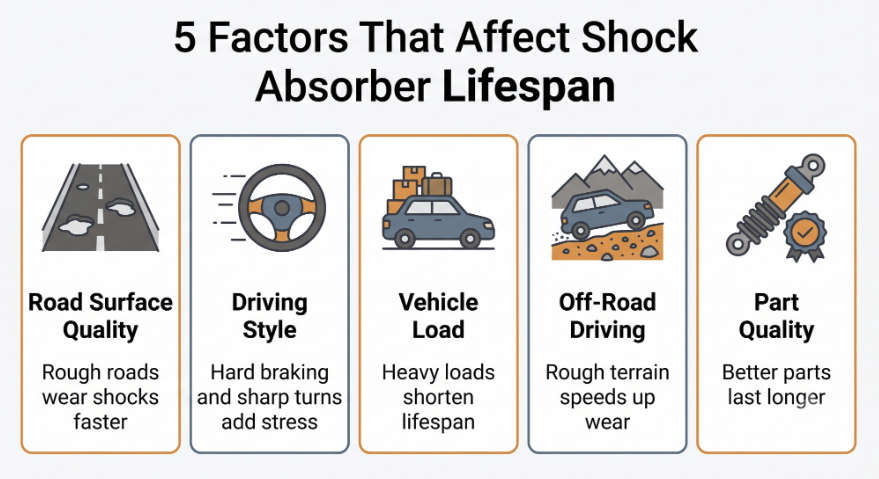
1. Road surface quality. This is usually the single biggest factor. Drivers who regularly deal with potholes, speed bumps, or unmade roads will typically see shocks wear out sooner than those on smooth, well-kept routes even if the total mileage is the same.
2. Driving style. Gentler acceleration, braking, and cornering put less strain on the suspension. Aggressive driving does the opposite, and the wear adds up faster than most drivers expect.
3. Vehicle load. This is one of the more overlooked causes of early wear. A car that's regularly loaded with passengers, luggage, or towing equipment is asking more of its shocks on every single trip.
4. Off-road or unsurfaced driving. Anyone driving regularly on gravel, farm tracks, or genuinely rough terrain should expect to need fresh shock absorbers noticeably sooner than a typical urban or motorway driver.
5. Part quality. Not all shock absorbers are built to the same standard. This is where it's worth being selective a well-made set from a trusted brand will generally outlast a budget alternative by a meaningful margin, which is why it's worth taking the time to shop shock absorbers from a reputable range rather than picking the cheapest option available.
Where your car is likely to fall in that range
Given the typical range of 50,000 to 100,000 miles, here's a quick way to estimate where your car is likely to land:
● Closer to 100,000 miles (or 5 years): smooth roads, steady driving, no regular heavy loads, good-quality parts fitted originally.
● Closer to 50,000 miles (or 4 years): rough or unmade roads, frequent heavy loads, off-road driving, or budget parts fitted at the last service.
This is why a mileage figure alone doesn't tell the full story. Two owners of the same model, both at 60,000 miles, might be in completely different positions depending on how that mileage was covered.
Warning signs your shocks are wearing out
Since the lifespan is a range rather than a fixed point, it helps to know what to look and listen for as the estimate approaches:
● Excessive bouncing after a bump, rather than the car settling quickly
● A vibrating or unsettled feeling through the steering wheel
● Uneven tyre wear
● A noticeably harsher ride than before
● Visible fluid around the shock body, pointing to a leak
● Longer braking distances
● Knocking or clunking noises over bumps
One symptom on its own isn't always significant. Several appearing together is a much clearer signal that the shocks are reaching the end of their service life, and it's a good moment to browse our shock absorber range and get a fresh set lined up before the ride and handling are affected further.
Planning ahead rather than reacting
There's no fixed expiry date for a shock absorber. The 4-to-5-year, 50,000-to-100,000-mile range is a solid starting point, but road conditions, driving style, vehicle load, and part quality all shift that number up or down. Knowing which of these apply to your own driving is the most reliable way to judge where your car sits and when it's worth planning ahead rather than waiting for the ride to feel wrong.