

Harrogate sits at an altitude of roughly 100 to 200 metres, right on the edge of the Yorkshire Dales, with the flatter Vale of York to the east and the upland fells rising to the west and north-west.
The Yorkshire Dales National Park as a whole averages around 298 metres in elevation.
Drive out from the town centre in almost any direction and you're quickly into rolling, undulating terrain, with roads that climb and drop repeatedly rather than running flat for any real distance.
That kind of driving puts a very specific kind of strain on a car's brakes.
The short explanation is this: on hilly roads, brake pads spend far more time doing sustained work than they would on a flat route, and that sustained contact is what generates heat.
Each time a driver holds the brakes on a descent rather than just tapping them, friction between the pad and the disc keeps building heat instead of dissipating it between short, occasional stops.
Anyone who drives these routes regularly will notice this more than someone commuting on flat, straight roads, and it's worth checking pad condition before it becomes a problem.
There's a good range of brake pads from autodoc.co.uk to suit different car models, including options built with this kind of use in mind.
Why Harrogate's surrounding roads generate more heat than flat routes
On a flat, straight road, braking tends to be occasional and brief.
A driver slows for a junction or a roundabout, then the pads have time to cool before the next stop.
On the hilly roads around Harrogate, particularly heading towards the Dales or through the smaller villages in the surrounding countryside, drivers often need to hold light, continuous pressure on the brakes during a descent to keep speed under control, rather than braking in short bursts.
This sustained pressure keeps the pad in contact with the disc for much longer stretches, and the heat generated has less opportunity to disperse before the next uphill or downhill section begins.
What happens when brake pads are working under sustained heat
Pads that are regularly subjected to this kind of prolonged heat can start to glaze over time.
The surface hardens and becomes less able to grip the disc effectively.
This often shows up as a spongier pedal feel, a longer stopping distance than expected, or a faint burning smell after a long descent.
On a flat road these signs might barely register, but on a route with repeated climbs and drops, they tend to become noticeable much sooner.
Signs worth watching for on hilly routes:
● The pedal feels less firm or requires more travel than usual.
● There's a faint burning smell after a long descent.
● Stopping distances seem longer than expected, even on dry roads.
● A slight vibration or pulsing is felt through the pedal when braking.
Drivers who regularly cover routes towards the Dales or through the hillier parts of North Yorkshire tend to notice these signs earlier than those who mostly drive on flatter, more direct routes.
Comparing brake pad demand across different road types
The diagram below illustrates this pattern along a typical stretch of undulating road near Harrogate.
On the descent, sustained brake engagement is shown moving from cool blue through to overheated orange and red, as the pad stays in contact with the disc without a break.
On a flat section, by contrast, braking is occasional, and the pad remains cool throughout, since there is no continuous demand placed on it.
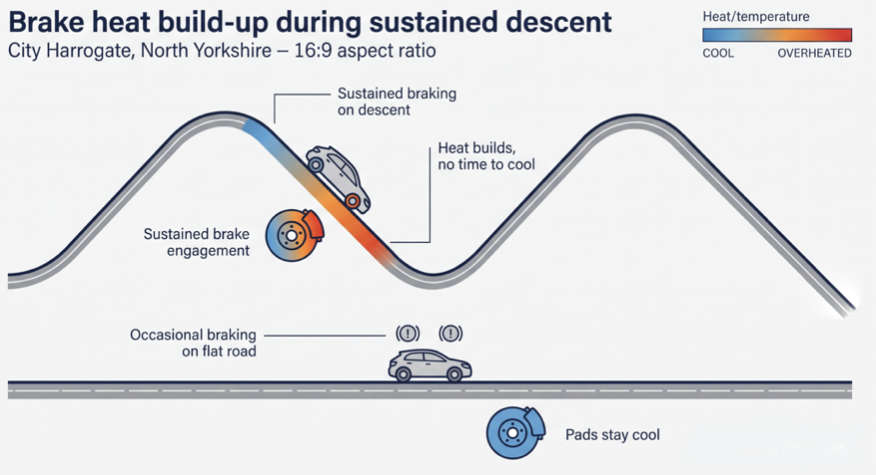
Brake heat build-up during sustained descent, illustrating the contrast between prolonged braking on a hill descent and occasional braking on a flat road, with a heat scale from cool to overheated.
This pattern can be broken down further by road type:
|
Road type |
Braking pattern |
Heat build-up risk |
|
Flat, straight road |
Occasional, brief braking |
Low |
|
Rolling hills around Harrogate |
Sustained braking on descents |
High |
|
Steep Dales roads |
Prolonged, heavy braking |
Very high |
|
Motorway or dual carriageway |
Rare braking at speed |
Low |
Taken together, the diagram and the table point to the same conclusion.
It isn't simply the number of hills that matters, but how long the brakes are held on during each descent, a pattern that's common on the roads surrounding Harrogate.
What to look for when choosing brake pads for hilly driving
Compatibility with the exact car model is the starting point, since pad size and composition vary between vehicles.
For drivers who regularly cover hilly routes, it's worth paying attention to a pad material with good heat resistance, so performance stays consistent even after a long descent.
The quality of the friction material also affects how well the pad recovers once it's had a chance to cool down between climbs.
Pads with these properties are available for most car models, suited to drivers who spend a lot of time on the undulating roads around Harrogate and the wider Dales.
Keeping the brakes ready for the hills
Between the rolling countryside on Harrogate's doorstep and the steeper roads further into the Dales, this part of North Yorkshire asks more of a car's brakes than a flat commute ever would.
Checking pad condition regularly, particularly before longer trips into hillier terrain, helps keep braking consistent exactly when a long descent calls for it.