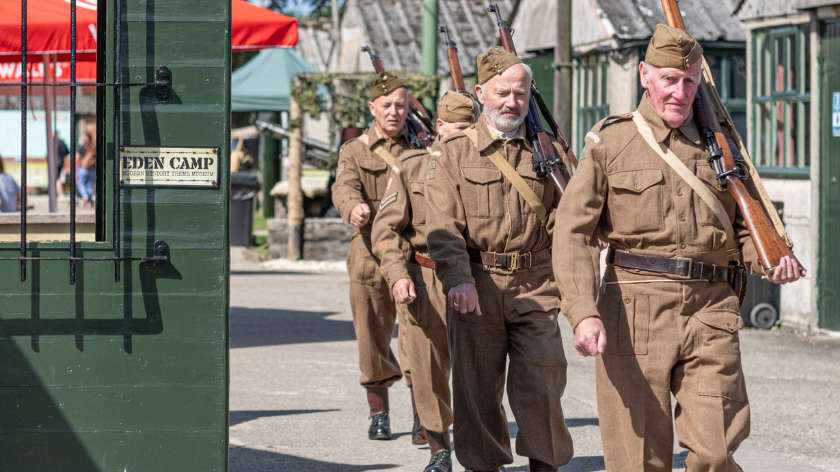



A Ripon metal detectorist has described the Bayeux Tapestry as a "medieval stitch-up" for leaving out one of Yorkshire's most significant battles.
Simon Richardson, who runs Fossil Treasures at HALLS of Ripon, has spent six years investigating the location of the Battle of Stamford Bridge alongside fellow detectorist John Benfield.
The battle took place on 25th September 1066, when King Harold Godwinson defeated a Viking army led by Norwegian King Harald Hardrada.
Just 19 days later, Harold was killed at the Battle of Hastings – the Norman victory depicted in the world-famous tapestry.
Simon believes the omission of Stamford Bridge overlooks a crucial part of the story.
Speaking to Tim Flanagan of the Rejoicing in Ripon Blog, Simon said:
“It looks like Stamford Bridge was stitched up by the tapestry’s embroiderers, who were clearly more interested in pleasing their new Norman masters than telling the whole story of what happened in 1066.”
The 70-metre tapestry, which depicts the events surrounding the Norman Conquest, is being exhibited at the British Museum until July 2027.
Simon said:
“The Battle of Stamford Bridge in which Norwegian King Harold Hardrada was killed and his Viking army was routed, took place on September 25th of that world-changing year, just 19 days before the Battle of Hastings.
“They were of equal historical importance, but with the demise of Anglo-Saxon King Harold at Hastings, it appears that a blind eye was turned to his heroic efforts in the north as the tapestry extensively features the Norman Conquest, which began in the south.”
Simon and John’s research on the banks of the River Derwent, east of York, has attracted national and international attention, including coverage in The Times and on BBC’s The One Show.
Their discoveries also feature in 1066: The Lost Battlefield, a documentary presented by historian Dan Snow on History Hit.
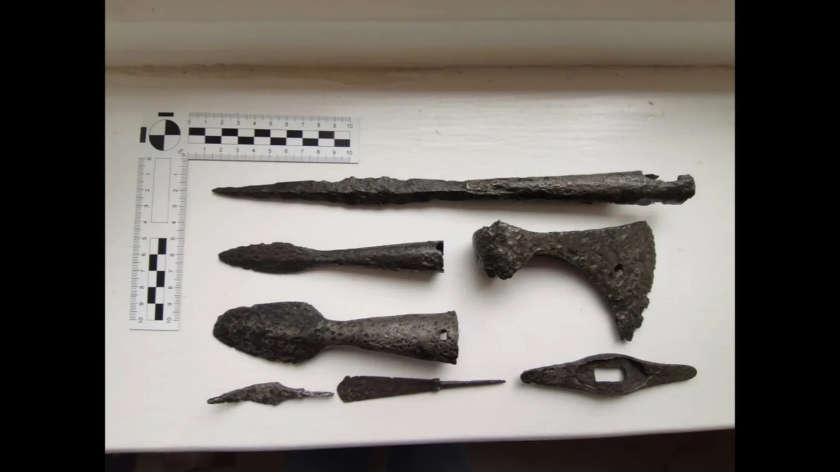
The pair believe artefacts recovered around a mile south of the recognised battlefield suggest the fighting took place elsewhere.
Simon, whose expertise has been called upon at 15 major battlefield sites across Europe, said:
“In addition to missing out on the tapestry timeline, the discoveries that John and I have made since we were given official permission to explore the Stamford Bridge site six years ago, shows that for centuries, historians and archaeologists have mistakenly ‘identified’ the area where they claim the battle took place.
“Artefacts that we have found a mile to the south of the ‘officially recognised’ battlefield, include parts of Viking swords, arrowheads, spears and mail armour, strongly suggesting that the map needs to be redrawn.”
Simon’s Fossil Treasures business sells items dating back hundreds of millions of years, including finds unearthed on the Yorkshire coast.
His battlefield investigations have covered sites dating from the medieval period through to the Second World War.
Simon said:
“Dan Snow said in The Times article and on his streaming site that he and other experts are convinced that we have found the correct location and John and I will continue our search for further evidence to support our claim.
“In the meantime, all of the artefacts that we have discovered are in secure storage after being recorded by specialists at the British Museum.”
 Valley Gardens among top winners at Yorkshire in Bloom awards
 New opening date revealed for Harrogate bookshop
 Harrogate toy retailer cuts prices every time Town striker scores
 North Yorkshire hospices warn of cuts and closures as funding crisis deepens
 Diesel prices rise above £2 a litre in Harrogate area
 New woodland sauna and cold plunge opens in Harrogate
 Brackenfield School in Harrogate praised by inspectors ahead of 50th anniversary
 Harrogate hotel chef shortlisted for 'Oscars of hospitality'
 Public consultation could be held on Ripon street pedestrianisation plans
 Masham pupils surprise lifelong resident on her 100th birthday
 Knaresborough Matalan to reopen following refurbishment
 £5m project begins to improve River Nidd water quality
 Campaigners call for changes to school transport consultation amid "tick-box" criticism
 Martin House care team completes 100-mile relay from coast to hospice
 New Harrogate youth hub to help young people into work
 64 arrests made in North Yorkshire Police's biggest ever operation
 Police appeal after woman bitten by dog in Harrogate bar
 Knaresborough terrace repair may not begin until 2027 as 2,000 sign petition
 Harrogate BID wins fifth consecutive Gold at Yorkshire in Bloom
 Former farmer scoops Starbeck in Bloom prize with homegrown onion