

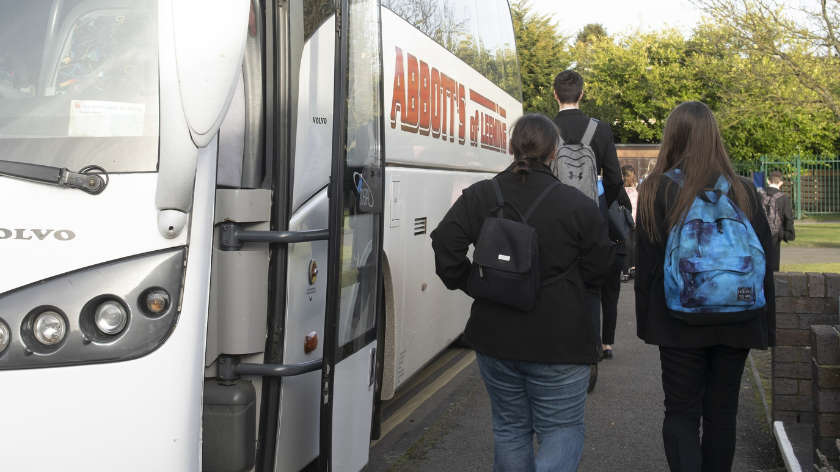
North Yorkshire Council has been called on to show evidence of cost savings resulting from its controversial home-to-school transport changes as Reform say they will cancel the policy if they get chance.
The authority’s children and families overview and scrutiny committee heard doubts from opposition councillors and campaigners that the savings claimed by the council would be found.
The meeting at County Hall in Northallerton was called to discuss the recently published post-implementation review (PIR) of the policy change, which means the council only offers free transport to a child’s nearest school rather than a system based on school catchment areas.
The change was made by the authority in a bid to reduce an annual school transport bill of more than £52m.
Liberal Democrat councillor Felicity Cunliffe-Lister told the meeting that the review was “not thorough enough for any conclusions to be drawn with any confidence”.
She added:
“We learn that policy savings have amounted to 417 fewer journeys, seven fewer vehicles, and total vehicle capacity is reduced by sixty-two.
“But the report gives no breakdown showing the value of these savings. Considering that the review was delayed while these savings were assessed, why is this vital information missing now?
“We know that home-to-school transport costs are complex, so why are the predicted savings based on current average cost per child on the back of an envelope calculation making assumptions about numbers falling, and I quote, ‘based on trends that are promising but not conclusive’?”
Councillor Peter Lacey, leader of the Liberal Democrat group, added:
“I still have concerns that we’re basing a long-term decision on assumptions rather than real cashable savings.”
Jo Foster, from the campaign group, the School Transport Action Group (STAG), claimed the policy was “badly broken”.
She added:
“It’s lurching from crisis to crisis, creating absolute carnage as it goes on, hurting families, hurting children, and undermining schools across North Yorkshire.”
The campaigner called on the council to “show me the money”, adding: “The original traction was £4.2m, but that has not materialised, and you admit that in your PIR. So why are you putting people through all this pain for zero gain?”
Reform councillor Mike Jordan said the policy change had created a “mess” and also questioned the level of savings being made.
He added:
“If in a position to do so, our group will, at the earliest opportunity, revert back to catchment, which is what we should be using.”
The review foretasted that the changes would lead to savings of £3.7m by the end of the seven-year implementation period, although the savings could be as low as £2.2m and as high as £4.4m.
Howard Emmett, assistant director of strategic resources at the authority, told the meeting that the new policy had already led to savings in 2025/26 of around £343,000.
He added:
“The savings assessment that you’ve got in the PIR report reflects the initial indications that numbers of vehicles are down, the average distances are down, the vehicle sizes are down, and the income for additional paid travel permits is up, which is an indicator of potential future savings.
“We also know from the analysis that, for example, in one of our secondary schools, we’ve got two 73- seater buses being replaced by one 50-seater bus.
“That is an example of how those savings are coming through.”
Rachel Joyce, assistant chief executive for local engagement, defended the review which she led.
She said:
“The PIR makes clear that there are improvements to be made to the implementation of the policy.
“However, the finding of the report is that the objective of the original policy changes are broadly on track to be met based on the early data available.”
The officer said a return to a system based on catchment would create “additional issues”.
She added:
“Statutory guidance requires the nearest school to be used for calculating eligibility.
“Including catchment would be an additional discretion, which would prevent the savings being made and would restore an inconsistent set of arrangements whereby some children would be eligible for transport to multiple schools, whilst other children would only be eligible for transport to one school.”
The recommendations of the review will now be discussed by the council’s executive on Friday.
 Kate Mosse and Prue Leith among stars of Harrogate Literature Festival
 Ripon among UK's top cities for missing parcels
 Tourist tax ‘has to be done right’, says North Yorkshire Mayor
 Harrogate volunteers give 75 hours to town centre clean-up
 Police appeal to identify camping equipment recovered in Harrogate
 Nearly two million visits made to North Yorkshire libraries in a year
 Triple Tripadvisor success for local hospitality operator
 Man arrested after stabbing threat at Harrogate Morrisons
 Pavements near Royal Pump Room given a deep clean
 Harrogate pub manager to take on Everest trek for hospitality charity
 Harewood House unveils new Elf Village for Christmas
 Harrogate cyclists conquer Pyrenees challenge in twin town
 William and Victoria appeals for help after chairs taken from restaurant
 Former Leeds United star Ross McCormack joins Knaresborough Town
 Council rejects rumours that housing for the homeless would accommodate asylum seekers
 Ripon gritter manufacturer invests £1.1m in new laser cutter
 Northern expands mobility scooter access across its train fleet
 Plans unveiled for up to 53 homes at Hornbeam Park
 Grantley Hall boss named General Manager of the Year
 Harrogate buses join fight against town centre crime